From living rooms in India to a free weekend of Netflix
Research in India led to StreamFest, a free weekend of Netflix for anyone in India. Demand far exceeded what we planned for, but it didn't bring the sign-ups and revenue we were aiming for.
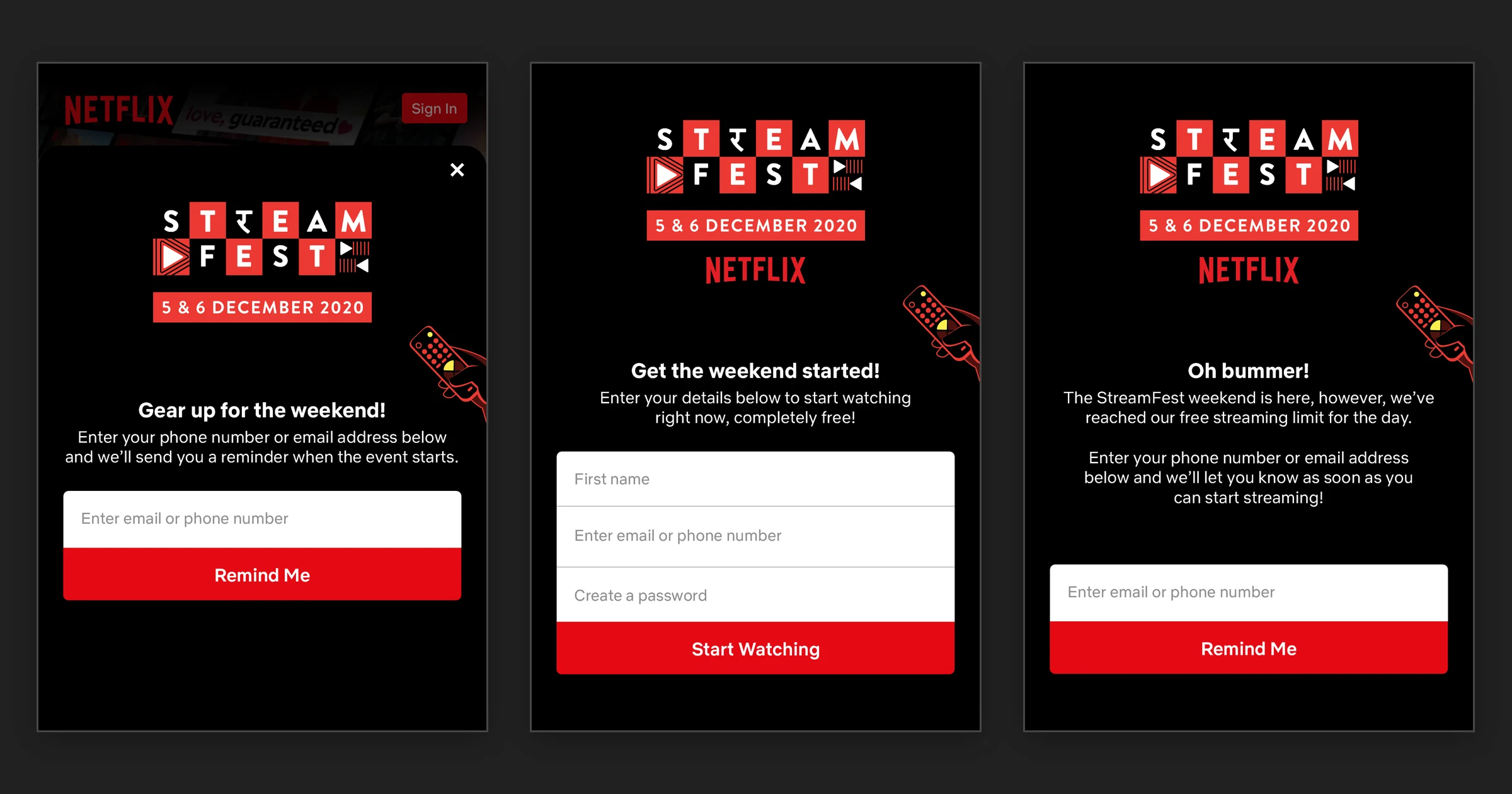
In brief
- The problem
- Plenty of people in India tried Netflix, but far fewer kept paying. The price felt too high for what people thought they'd get, many assumed the catalog was mostly English, and asking for payment details for a free trial broke their trust.
- What changed
- StreamFest hit capacity on its first day and created a lot of buzz, and the capacity plan let everyone who signed up get their two days. But it didn't produce the paid sign-ups and revenue we were measuring it against.
- My part
- I was one of two designers on a seven-week research immersion in Mumbai and Chennai, designing and prototyping the concepts we tested in market. In 2020, I co-led design on StreamFest with another designer. I designed the reminder sign-up and the registration page, including what visitors saw when the event was full.
Keep reading for the full story, or skip to the next case study, Turning widescreen trailers into vertical previews →
The full story
Lots of people in India tried Netflix, but few kept paying
In early 2019, I spent about seven weeks in Mumbai and Chennai with a small team from Growth: two designers, a PM, a researcher, a UI engineer, and a localization lead. Netflix had plenty of people in India trying the service, but far fewer of them stayed and paid. Our goal was to understand why and find ways to grow there.
Before we left, we met with experts across the company, from consumer insights to payments to customer service, and grouped what we learned into themes to test. In market, we visited people at home, ran diary studies, and held quick research sessions every few days to test new concepts on plans and pricing, payments, the free trial, language, and account sharing. I designed and prototyped concepts for those sessions, including one that let people choose their languages when they first signed up. We also tested browsing titles by category instead of one long gallery.
People told us the price was too high, and the trial felt like a trap
Three things came up again and again.
- The price was too high for the value. People thought Netflix had exciting shows and seemed better than Amazon Prime Video, but not better enough to justify a much higher price, especially since Prime came bundled with shopping. Many split the cost of a bigger plan with friends or family.
- Phones and downloads were the basics. It seemed like everyone had a phone. As one of our guides put it, someone might not be able to read or sign their name, but they could use a phone. For most, the phone was the main screen, and they expected to download shows to watch offline. Before streaming caught on, people passed around USB sticks and hard drives full of shows and movies, because internet access wasn’t everywhere or reliable.
- Local content was a must. Almost everyone knew the name Netflix, but many assumed it was mostly English shows and movies. People thought about what to watch by language, so the catalog needed to show what was there in Hindi and the other languages they spoke. And local meant more than Bollywood: what’s made in the south, around Chennai, is distinct from what’s made further north in Mumbai, and people wanted to see the shows and films from their own region.
The landscape was also shifting. Wired internet couldn’t reach most of the country, so companies like Jio were bringing wireless, cell-based internet across India. And less expensive TVs from Chinese brands were starting to arrive, so many people who couldn’t afford a TV would soon have options.
The free trial had its own problems. People didn’t understand why a free month needed a plan and a card, many didn’t trust services with their payment details, and recurring payments weren’t the norm. Some signed up planning to cancel before the month ended. When we came home, I argued that price had to come first, then making plans easier to choose, then making it feel less risky to try. One idea I proposed afterward let people create an account and browse Netflix before giving any payment details.
In 2020, StreamFest let anyone in India watch for free
Netflix ended the free trial in India in early 2020. Out of the immersion work came a different idea: StreamFest, a weekend when anyone in India could watch all of Netflix for free. You signed up with a name, an email address or phone number, and a password, with no payment details. It was meant to answer several problems we’d seen in India at once: you could try the whole catalog, including the local shows people didn’t know about, without handing over a card.
By then I was on Growth APAC, and I co-led the design with another designer. I designed everything before you got in: the reminder sign-up before the event and the registration page during it, using brand artwork from an outside agency. The other designer designed the experience inside Netflix during the event and the path to a paid membership afterward.
One page had to handle many situations
Most of my work came down to one page, netflix.com/StreamFest, and every situation a visitor might arrive in. Before the event, it collected an email address or phone number for a reminder. When the event began, it became a short registration form. If you’d already registered, it welcomed you back with a button to keep watching. If you were a former member who was already signed in, it was a single button. While writing the spec, I also added a state for people who were already signed in to Netflix.
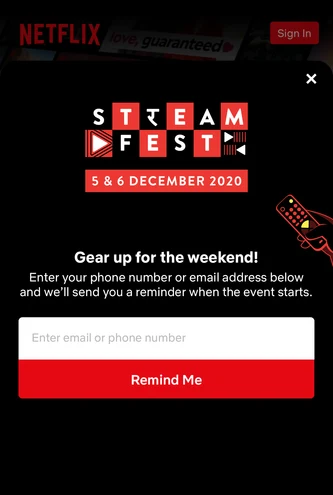
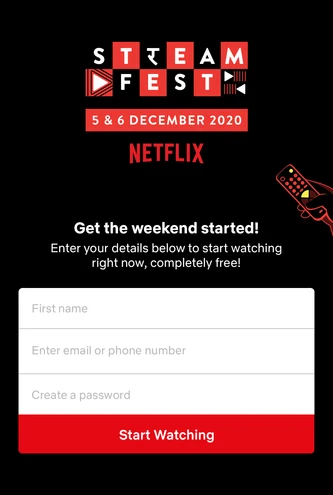
Before the event, the page collected reminders (left). During the event, it became a short registration form (right). The StreamFest logo and background art were created by an outside agency; I designed the page and its states.
The Netflix home page changed with the event too. Before StreamFest, a module promoting it sat second on the page; once the event started, it moved to the top. iPhone users needed their own path, because they couldn’t sign up inside the iOS app. After registering on mobile web, they saw a page telling them to download the app and sign in there.
We planned for more demand than we could handle
A free weekend for a country of more than a billion people meant no one knew how many would show up, and Netflix planned to limit how many free viewers could watch at once. So I designed the page for running out of room. Engineering had a switch for each stage: one paused reminder sign-ups before the event, and the other paused new registrations during it. When registrations paused, new visitors saw a page saying StreamFest was at capacity, with a form to leave an email or phone number. The copy promised to let them know as soon as they could start streaming. An FAQ on the page explained the limit before anyone hit it.
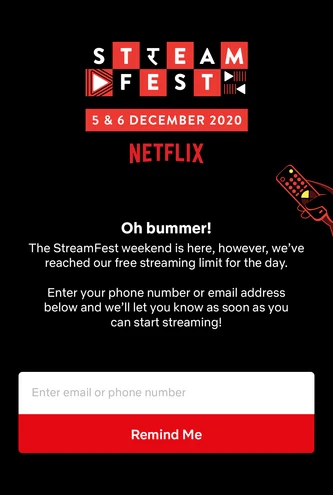
In August 2020, we ran remote research sessions with participants in India, using a prototype the other designer built. Before the real event, we ran a smaller, web-only version in Sri Lanka at the end of October to test the systems underneath. The engineers learned a lot from it, and we used what they found to prepare for India.
Far more people came than we expected, but few paid
StreamFest ran on December 5 and 6, 2020, and it was far more popular than we expected. It reached capacity on the first day. The capacity plan did its job: people who couldn’t get in left their details, and Netflix let them in over the following week, including a 48-hour extension that TechRadar reported. Sensor Tower estimated that Netflix’s app installs worldwide roughly tripled compared with the weekend before. Through the event and the week after it, I supported our engineering partners with design QA.
The business result was different. StreamFest was measured on paid sign-ups and revenue, and on those it fell short. Some people who watched for free went on to pay, but not nearly enough. It created a lot of buzz and interest, and very little of that turned into new members.
I still think a free weekend was a sound idea. It answered what we had heard about the free trial: people could try everything without handing over a card. But it couldn’t fix the price, which the immersion had already shown was the biggest barrier, and which I had ranked as our top priority when we came home. My sense is that two days showed people what Netflix was, but for most of them it still wasn’t worth what we were charging. We may also not have had enough local content yet to keep people coming back once the weekend ended.